The Sun Does a Flip according to NASA


Did the Earth Flip Over in the Past?

Written by Fraser Cain

Scientists have found evidence that the Earth might have flipped over in the past, completely shifting the orientation of its poles. The theory has been around for years; that a large mountain range or supervolcano might unbalance the spinning Earth. Over the course of millions of years, the Earth would change the orientation of its axis until the object was balanced at the equator again. The scientists found evidence of magnetic grains in layers of rock sediment on the ocean floor that maintain a record of the Earth's magnetic field over millions of years.

Imagine a shift in the Earth so profound that it could force our entire planet to spin on its side after a few million years, tilting it so far that Alaska would sit at the equator. Princeton scientists have now provided the first compelling evidence that this kind of major shift may have happened in our world's distant past.

By analyzing the magnetic composition of ancient sediments found in the remote Norwegian archipelago of Svalbard, Princeton University's Adam Maloof has lent credence to a 140-year-old theory regarding the way the Earth might restore its own balance if an unequal distribution of weight ever developed in its interior or on its surface.

The theory, known as true polar wander, postulates that if an object of sufficient weight — such as a supersized volcano — ever formed far from the equator, the force of the planet's rotation would gradually pull the heavy object away from the axis the Earth spins around. If the volcanoes, land and other masses that exist within the spinning Earth ever became sufficiently imbalanced, the planet would tilt and rotate itself until this extra weight was relocated to a point along the equator.

"The sediments we have recovered from Norway offer the first good evidence that a true polar wander event happened about 800 million years ago," said Maloof, an assistant professor of geosciences. "If we can find good corroborating evidence from other parts of the world as well, we will have a very good idea that our planet is capable of this sort of dramatic change."

Maloof's team, which includes researchers from Harvard University, the California Institute of Technology and the Massachusetts Institute of Technology as well as Princeton, will publish their findings in the Geological Society of America Bulletin on Friday, Aug. 25.

True polar wander is different from the more familiar idea of "continental drift," which is the inchwise movement of individual continents relative to one another across the Earth's surface. Polar wander can tip the entire planet on its side at a rate of perhaps several meters per year, about 10 to 100 times as fast as the continents drift due to plate tectonics. Though the poles themselves would still point in the same direction with respect to the solar system, the process could conceivably shift entire continents from the tropics to the Arctic, or vice versa, within a relatively brief geological time span.

While the idea that the continents are slowly moving in relation to one another is a well-known concept, the less familiar theory of true polar wander has been around since the mid-19th century, several decades before continental drift was ever proposed. But when the continents were proven to be moving under the influence of plate tectonics in the 1960s, it explained so many dynamic processes in the Earth's surface so well that true polar wander became an obscure subject.

"Planetary scientists still talk about polar wander for other worlds, such as Mars, where a massive buildup of volcanic rock called Tharsis sits at the Martian equator," Maloof said. "But because Earth's surface is constantly changing as the continents move and ocean crustal plates slide over and under one another, it's more difficult to find evidence of our planet twisting hundreds of millions of years ago, as Mars likely did while it was still geologically active."

However, the sediments that the team studied in Svalbard from 1999 to 2005 may have provided just such long-sought evidence. It is well known that when rock particles are sinking to the ocean floor to form layers of new sediment, tiny magnetic grains within the particles align themselves with the magnetic lines of the Earth. Once this rock hardens, it becomes a reliable record of the direction the Earth's magnetic field was pointing at the time of the rock's formation. So, if a rock has been spun around by a dramatic geological event, its magnetic field will have an apparently anomalous orientation that geophysicists like those on Maloof's team seek to explain.

"We found just such anomalies in the Svalbard sediments," Maloof said. "We made every effort to find another reason for the anomalies, such as a rapid rotation of the individual crustal plate the islands rest upon, but none of the alternatives makes as much sense as a true polar wander event when taken in the context of geochemical and sea level data from the same rocks."

The findings, he said, could possibly explain odd changes in ocean chemistry that occurred about 800 million years ago. Other similar changes in the ocean have cropped up in ancient times, Maloof said, but at these other times scientists know that an ice age was to blame.

"Scientists have found no evidence for an ice age occurring 800 million years ago, and the change in the ocean at this juncture remains one of the great mysteries in the ancient history of our planet," he said. "But if all the continents were suddenly flipped around and their rivers began carrying water and nutrients into the tropics instead of the Arctic, for example, it could produce the mysterious geochemical changes science has been trying to explain."

Because the team obtained all its data from the islands of Svalbard, Maloof said their next priority would be to seek corroborating evidence within sediments of similar age from elsewhere on the planet. This is difficult, Maloof said, because most 800-million-year-old rocks have long since disappeared. Because the Earth's crustal plates slide under one another over time, they take most of geological history back into the planet's deep interior. However, Maloof said, a site his team has located in Australia looks promising.

"We cannot be certain of these findings until we find similar patterns in rock chemistry and magnetics on other continents," Maloof said. "Rocks of the same age are preserved in the Australian interior, so we'll be visiting the site over the next two years to look for additional evidence. If we find some, we'll be far more confident about this theory's validity."

Maloof said that true polar wander was most likely to occur when the Earth's landmasses were fused together to form a single supercontinent, something that has happened at least twice in the distant past. But he said we should not worry about the planet going through a major shift again any time soon.

"If a true polar wander event has occurred in our planet's history, it's likely been when the continents formed a single mass on one side of the Earth," he said. "We don't expect there to be another event in the foreseeable future, though. The Earth's surface is pretty well balanced today."
 The Pole Shift in 2012 -What the Mayas knew was coming?

There are many who believe the Mayan end calendar date will signify the end of the world.  The archaeologist are of a very different opinion of the matter some believe the 2012 date is wrong. 

How to survive the 2012 Polar shift!  In the land down under.


 Pole Shift ?

Beginning in the 1920's, geologists discovered traces of the last few magnetic reversals in rock samples from around the world. Between 730,000 years ago to today, we have had the current magnetic conditions where the South-type magnetic polarity is located in the Northern Hemisphere near the Arctic. Geologists call this the Brunhes Chron. Between 730,000 to 1,670,000 years ago, Earth's magnetic poles were reversed during what geologists call the Matuyama Chron. This means that the North-type magnetic polarity was found in the Northern Hemisphere. Notice that the time since the last reversal (the end of the Mayuyama Chron) is 730,000 years. This is a LOT longer than the 200,000 years!

Some scientists think that we may be overdue for a magnetic reversal by about 500,000 years!

Is there any evidence that we are headed towards this condition? Scientists think that the sudden, rapid change in our magnetic pole location is one sign of a significant change beginning to occur. Another sign is the actual strength of Earth's magnetic field.

Scientists are convinced that Earth's magnetic field is created by currents flowing in the liquid outer core of Earth. Like the current that flows to create an electromagnet, Earth's currents can change in time causing the field to increase and decrease in intensity. Geological evidence shows that Earth's field used to be twice as strong 1.5 billion years ago as it is today, but like the weather it has gone through many complicated ups and downs that scientists don't have a real good explanation for, or ability to predict. But the fossil evidence does tell us something important.

In the 730,000 years since the last magnetic reversal, Earth's field has at times been as little as 1/6 its current strength. This happened about 200,000 years ago. Also, around 700 AD it was 50% stronger than it is today. There have been many sudden ups and downs in this intensity, but some scientists think that conditions are rapidly becoming very different than the past historical trends have shown.

In the last 150 years, the strength of Earth's field has decreased by 5% per century. This doesn't seem like a very fast decrease, but it is one of the fastest ones that has been verified in the 800,000 year magnetic record we now have. At this rate, in 10 centuries we will be 50% below our current field strength, and after 2000 years we could be at zero-strength. The data on past reversals seems to show that, when the field reaches 10% of its current strength, a magnetic reversal can be triggered. It has been 730,000 years since the last reversal ended. We are certainly long overdue for a reversal, by some statistical estimates.

So, what will happen when the field reverses?

The fossil record, and other geological records, seem to say 'Not much!'

Scientists have recovered deep-sea sediment cores from the bottom of the ocean. These sediments record the abundance of oxygen atoms and their most common isotope: Oxygen-18. The increases and decreases in this oxygen isotope track the ebb and flow of periods of global glaciation. What we see is that, during the time when the last reversal happened, there was no obvious change in the glacial conditions or in the way that the conditions came and went. So, at least for the last reversal, there was no obvious change in Earth's temperature other than what geologists see from the 'normal' pattern of glaciation. By the way, because glaciation depends on the tilt of Earth's spin axis, this also means that a magnetic reversal doesn't change the spinning Earth in any measurable way.

Loess deposits in China have recently given climatologists a nearly unbroken, continuous record of climate changes during the last 1,200,000 years. What they found was that the sedimentation record shows the summer monsoons and how severe they are. The only significant variation in the data could be attributed to the coming and going of glacial and inter-glacial periods. So, summer monsoons in China were not affected by the reversal in any way that can be obviously seen in the climate-related data from this period.

The fossil record, at least for large animals and plants, is even less spectacular when it comes to seeing changes that can be tied to the magnetic reversal.

The Brunhes-Matuyama reversal happened 730,000 years ago during what paleontologists call the Middle Pleistocene Era (100,000 to 1 million years ago). There were no major changes in plant and animal life during this time, so the magnetic reversal did not lead to planet-wide extinctions, or other calamities that would have impacted existing life. It seems that the biggest stresses to plant and animal life were the comings and goings of the many Pleistocene Ice Ages. This led very rapidly to the evolution of cold-tolerant life forms like Woolly Mammoths, for example.

So, it seems that we may be headed for another magnetic reversal event in perhaps the next few thousand years. This event, based on past fossil and geological history, will not cause planet-wide catastrophies. The biosphere will not become extinct. Radiation from space will not cause horrible mutations everywhere. Ocean tides will not devastate coastal regions, and there will certainly not be volcanic activity that leads to global warming.

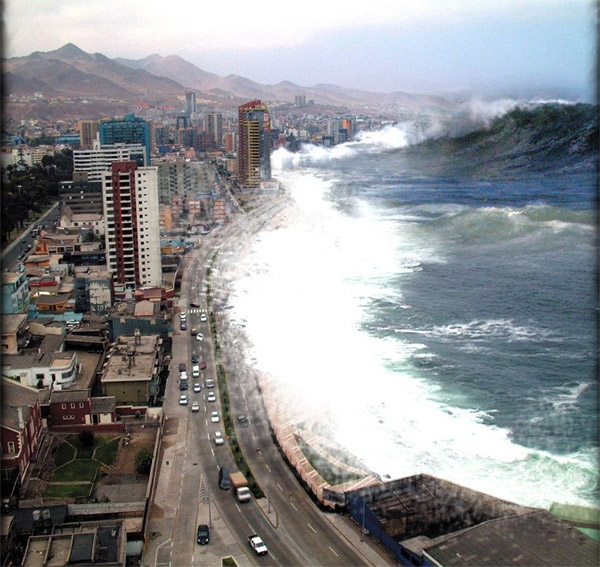
Deadly Tsunami's Will Cause Extinction on land and Sea

Artic Animals Disappear?

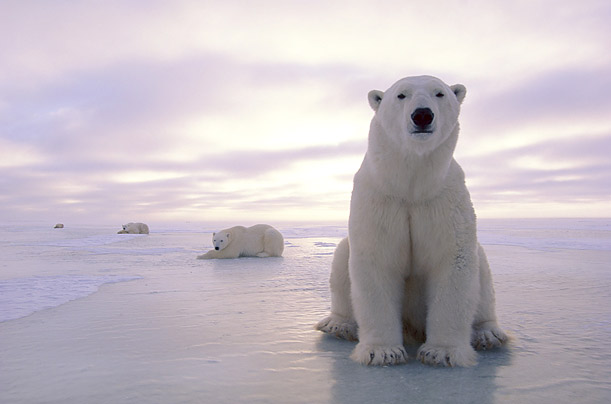
 According to Nastional Geographic two-thirds of the world's polar bears could disappear by 2050 as global warming continues to melt the Arctic's sea ice, according to a series of U.S. government studies released last Friday. Thier dependence on sea ice makes them particularly vulnerable to warming temperatures. As the sea ice melts sooner each summer, the bears will be forced to come ashore earlier and face food shortages before they have stored enough fat to last through the season.

 "Arctic ice cap to melt faster than feared, scientists say,"

 What about the Quatenary extinctions?

 Emperor penguins march toward extinction?

 Pole Shift

 It is generally accepted that the Earth's crust "floats" on a turbulent molten lava ocean. It is turbulent because the earth core is spinning faster than the earth crust. Have you noticed that the wind and ocean currents spin faster than the crustal land mass? The faster spinning center is pulling the winds and tides around by its massive gravitational pull. Just beneath our feet lies the source for every future volcano, earth quake, tsunami, and polar shift. Any sense of absolute safety and security we might have about the Earth is false. Anyone who has experienced an earth quake of 7 or above on the Richter Scale will admit this to be an absolutely terrifying experience. In a very brief moment, our true vulnerability and utter dependence upon the earth for stability is revealed. And govt. is powerless to do anything about it.

Science has discovered a relationship between lunar phases (full moons) and the occurance of earth quakes, volcanic eruptions, and tsunamis. This evidence suggests that earth quakes, volcanos, tsunamis, and earth shifts are more likely to occur around the time of extremely high tides. This probably means that there is a "tide" in the lava ocean under the crust that probably causes these events.

Albert Einstein was "electrified" when he learned of Charles Hapgood's theory in "Path of the Poles", whereby ice build-up at the polar caps could eventually cause the crust to "slide" over the lava ocean until the centrifugal force of the spinning Earth brought those ice caps around to the equator. Geological evidence suggests that something like this has happened repeatedly during the "life" of the planet; the magnetic poles seem to have shifted at least 171 known times. In other words, a "critical mass" of ice, coupled with an extremely high lunar influence, may be all that is necessary to trigger the next polar shift in the Earth's crust; leading to massive earth quakes, volcanos, and tsunamis beyond the scope of our present imaginations. The spinning earth core maintains its usual momentum, the magnetic poles remain in place, but there appears to be a polar/earth shift because the crust has slid over the magnetic poles! Charles Hapgood's theory has never been disproven.

Much as we hear about the ice melt-down at the poles due to climate change and global warming (supposedly caused by the activities of mankind), this is not in fact reducing the ice masses residing on polar land. The ice shelves are breaking away rapidly, but these ice masses floating upon the ocean have never added to any polar imbalance, and cannot cause a polar shift. On the other hand, a rise of one degree in the polar air temperatures will actually increase snowfall in those polar land regions simply because warm air is capable of carrying and depositing more moisture than cold air. In other words, even as the ice shelves are melting away, the land based snow, water, and ice masses are building up even more rapidly in Antarctica and in the northern areas of Greenland. This may very well be a natural and reccurring phenomena. In fact, recent revelations seem to confirm that 2 miles thick of pack ice on Antarctica has built up in as little as 4000 years! For many years scientists thought Antarctica has been ice laden for hundreds of thousands of years. They reasoned that each repeating pattern of ice rings showing alternating packed snow and solid ice represented the annual seasons of winter and summer. In other words, one ring pattern equaled one year. And there are around 200,000 such rings in a 2 mile ice core sample. But recently that has been brought into question. It seems that those ring patterns simply represent snow/thaw/freeze cycles; cycles that can actually repeat themselves several times in a single day! So, if there are only 75 such cycles in a year, the entire 2 miles of ice and snow on Antarctica was deposited since 100 AD. It is probably more likely, however, that 30 or 40 such cycles occur each year placing the beginning of ice on Antarctica around 4000-5000 years ago. Interestingly enough, this would roughly corespond to the hypothesis of a polar shift occurring around that same time!


Magnetic Weakening of Earth's Magnetic Field, Magnetic Strength Decreasing

At the time of the dinosaurs, the Earth's magnetic field was at 2.5 gauss which was 80% stronger than it is now. It is believed that the Earth's magnetic field could drop to 0, especially during a pole shift, and no one really knows what would happen if that occurs. A few things that are definitely going to happen if the Earth's magnetic field drops to 0 is that all electronic devices will fail, become damaged, and possibly irreparable. Satellites would be lost. Direction based on magnetism would be obsolete, and even bird migrations would be completely interrupted, which in essence would endanger those types of species.